
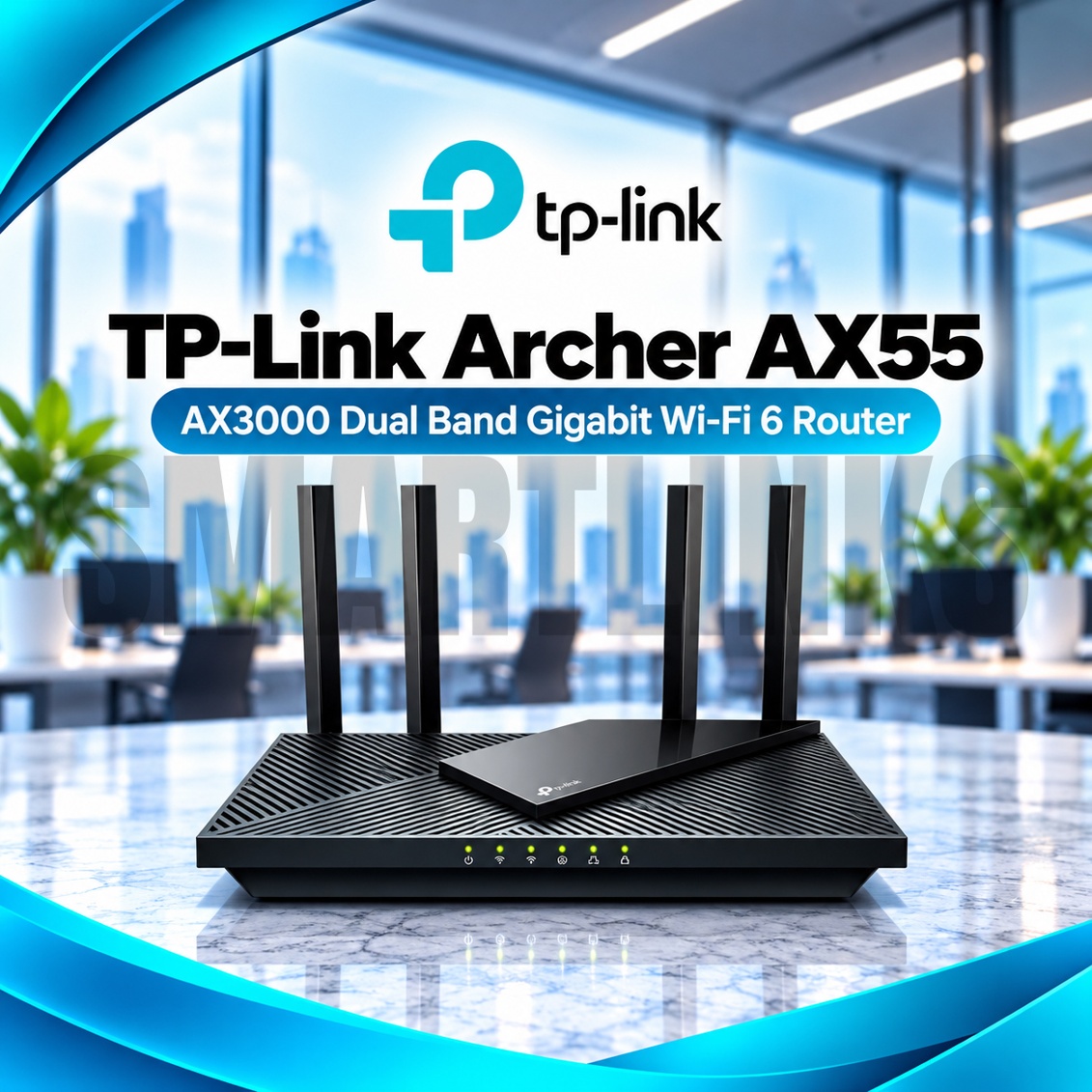




TP-Link Archer AX55 AX3000 Dual Band WiFi 6 Gigabit Router – 2402Mbps 5GHz, 160MHz, USB 3.0, EasyMesh & WPA3

- AX3000 Dual-Band WiFi 6 – Modern 802.11ax wireless connectivity
- 2402Mbps on 5GHz – High-speed wireless links
- 574Mbps on 2.4GHz – Everyday wireless connectivity
- 160MHz Channel Width – Increased capacity for compatible devices
- 4 Fixed External Antennas – Wider signal distribution
- Beamforming – Focused wireless transmission
- OFDMA and MU-MIMO – Efficient multi-device communication
- 5 Gigabit Ethernet Ports – One WAN and four LAN
- USB 3.0 Port – Compatible file and media sharing
- EasyMesh / OneMesh – Compatible mesh expansion on supported firmware
- WPA3 Security – Modern wireless encryption
- TP-Link HomeShield – Security and parental control features
- Target Wake Time – Power efficiency for compatible clients
- Router and Access Point Modes – Flexible installation
- TP-Link Tether App – Smartphone setup and management
- Discover More: TP-Link Wifi Routers
Description

TP-Link Archer AX55 AX3000 Dual Band WiFi 6 Router
The TP-Link Archer AX55 is a dual band WiFi 6 router built for connected homes and small offices. It combines AX3000 wireless capacity, Gigabit Ethernet connections, USB storage sharing, and practical security tools. Whether your household streams videos, attends online classes, works remotely, or plays multiplayer games, this router helps distribute an existing broadband connection across compatible devices without requiring a complicated installation.
AX3000 Dual Band Wireless Speeds
The Archer AX55 provides theoretical wireless link speeds up to 2402Mbps on 5GHz and 574Mbps on 2.4GHz. Its faster 5GHz connection suits demanding devices, while 2.4GHz can offer useful reach for everyday equipment. AX3000 refers to combined wireless link rates rather than guaranteed internet speed. Actual performance depends on your broadband subscription, connected devices, walls, neighboring networks, and radio interference.
160MHz Channels and WiFi 6 Efficiency
Support for 160MHz channels allows compatible 5GHz clients to use wider bandwidth where regulations and surrounding conditions permit. OFDMA and MU-MIMO help manage communication with multiple supported devices. Target Wake Time can reduce unnecessary wireless activity for compatible battery powered equipment. These technologies improve potential efficiency, but results vary according to client capabilities, firmware, channel availability, and household traffic.
Four Antennas and Beamforming
Four fixed high performance external antennas distribute wireless signals around suitable indoor spaces. Beamforming directs transmission toward compatible devices, helping maintain useful connections in supported conditions. Concrete walls, metal furniture, electrical equipment, and distant rooms can still weaken reception. Position the router in a central, open location with adequate ventilation. Its antennas are fixed and are not intended for routine removal.
Gigabit Ethernet and USB Sharing
One Gigabit WAN port connects to a compatible modem, fiber ONT, or Ethernet broadband service. Four Gigabit LAN ports support wired computers, televisions, consoles, and network switches. The USB 3.0 port enables compatible storage sharing through supported file and media services. Transfer speeds depend on the connected drive and network. This standard AX55 model does not provide a 2.5Gbps Ethernet port.
Mesh Expansion and Flexible Modes
The Archer AX55 supports compatible mesh expansion, including EasyMesh on supported firmware and regional hardware revisions. OneMesh compatibility is also documented for certain versions. Check the exact unit and companion devices before advertising interoperability. Router Mode shares your broadband connection, while Access Point Mode adds wireless coverage to an existing wired network. Mesh equipment is sold separately unless explicitly included.
HomeShield and Wireless Security
TP-Link HomeShield offers network scanning, parental control tools, and supported protection services. Certain advanced features may require a subscription. WPA3 encryption provides modern wireless security when devices support it, while guest networks create separate visitor access. Use strong administrator passwords, check connected devices regularly, and install official firmware for the correct hardware revision. Security settings should be reviewed after initial setup.
Simple Setup and Everyday Management
The TP-Link Tether app and browser interface help configure wireless names, passwords, device priorities, and supported network features. Some broadband providers require PPPoE credentials or VLAN settings. Check cables and internet service status before resetting equipment. USB sharing and remote access features should be configured carefully, especially when personal files are stored on connected drives.
Discover More from TP-Link
Want to explore more about TP-Link WiFi Routers? Visit the official TP-Link website for product insights, support, and the latest smart security solutions.
Official Resource: Explore TP-Link









Reviews
Clear filtersThere are no reviews yet.